Monday, 14 March 2016

The land of volcanoes and beyond

I'm aware that I maybe came across a little negative in my last post, but really I didn't mean to be. This has been an amazing trip and every day we see something new and exciting. That said, it's not fun every second of every day and every now and then the 'hard work' element of a trip like this comes to the fore, usually at a border crossing where half a dozen people are virtually hanging off your shirt sleeve insisting you must pay them to help you, or when we've inadvertently ridden down a wrong way street for the third time in half an hour and have to wrestle the bikes around in heavy traffic. Crossing into El Salvador was like a breath of fresh air. Immediately we were on smooth, sweeping pavement, heading off into the unknown. So many people skip El Salvador simply because you don't have to go through it. It's a very small country, a mere sliver along the southern edge of Honduras, but what it lacks in size it makes up in it's stunning scenery.


Getting into El Salvador was undoubtedly the easiest border yet. Nothing to pay, no insurance required, we just had to hand over the usual papers and then take a seat in the shade under a conveniently placed gazebo and wait. Quick it wasn't, but it wasn't a problem.


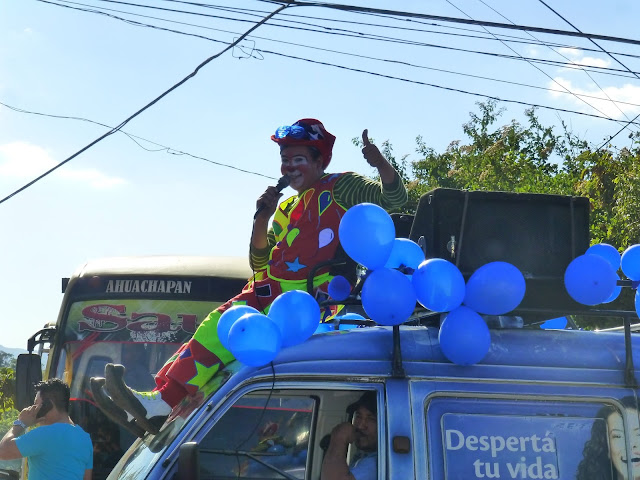
Upon leaving the border we decided to head down to the coast as we had plenty of time before nightfall. We were both enjoying not being on Guatemalan roads any longer, when we came upon the first town we had to pass, Ahuachapan. It was a Saturday so traffic was a little heavy. Then we came upon the reason - it was carnival day. Clowns, carnival queens, minions (everywhere we go there are minions), even batman and spiderman were in attendance. We tried a couple of side roads to bypass it but it soon became clear that we weren't going anywhere, so we parked up and enjoyed the parade. An hour later there was still no end in sight and with daylight hours running out, a local kid came to our aid and led us on his bike out of town, pointing us in the direction of the coast before waving us goodbye. My first impressions of this country and its people were good.


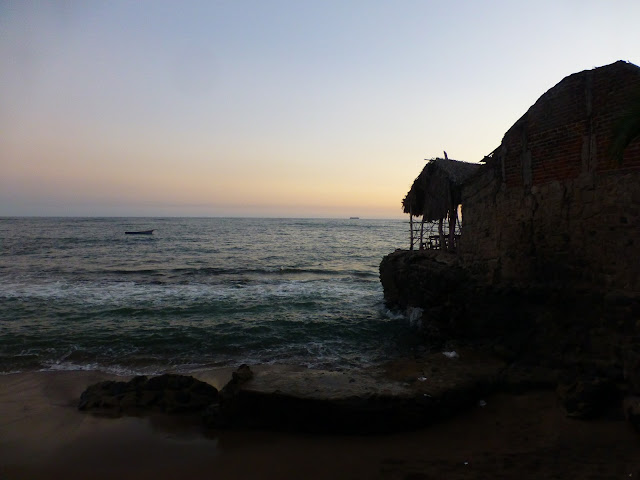
It still took some time to get out of town and along the way I discovered that I'd inadvertently stepped in some discarded bubble gum, which with the extreme heat served to stick my left foot firmly to the footpeg. It certainly made gear changes interesting. It was well past sunset when we rolled into a little dirt road town on the south coast. At first I was unsure that there actually was anywhere to stay there, but as we reached the end of the road a lady came running into the road waving her arms and indicating to us to come and look at her cabinas, clearly delighted to see customers. The room was basic and came complete with resident bats, but comfortable enough once we'd rigged up the mosquito net and the beach was beautiful.

The following morning we rode along the coast and we're struck by just how similar it is to Hwy 1 in California. But without the prices. El Salvador isn't exactly cheap, but it's not expensive either. Over the week that followed we wandered randomly, sometimes along the coast, occasionally inland a little more, enjoying what was, yet again, a place completely different to everywhere else in Central America. What we found was several small tourist hubs, mostly surf locations along the beach, but in between vast areas of undeveloped space. One place we stayed at, a hostel in the surf town of El Tunco, was exactly what the Dodo should be if someone made the effort required. Unfortunately though it lacked atmosphere and after a couple of nights we moved on.

We also visited San Salvador. Always in the tip ten lists of most dangerous cities in the world, we decided it was worth a look as we were there. The city itself is very much like any other larger Latin American city - busy, noisy and overpopulated. Evan had read about a military history museum and after several circuits of the city we finally found it. The gates were guarded by heavily armed soldiers who eyed us suspiciously as we rode up, but soon waved us through the gate when we explained what we were there to see. The museum is housed inside the city barracks and entering was like being in Cuba all over again. Not a visitor in sight and no sign that they had had any visitors for quite some time, yet the staff there went about their business as if it was a normal day at the office. With no designated parking area apparent we parked our bikes next to a row of tanks and spent the next couple of hours wandering around on our own, completely undisturbed. A couple of highlights here were the original Popemobile used during the two papal visits in the 80's and 90's and a topographical map of the whole of El Salvador which we spent several minutes looking at and planning our route to the Honduras border.


As we'll have a return journey, we skipped straight through Honduras on this occasion, only two hours to the Nicaraguan border. It didn't mean we were imune to having to pay the extortionate $35 Honduran vehicle import fee though, or complete the mountain of paperwork that was required to obtain said permit. Honduras really does have the most ridiculous entry requirements of all the Central American countries. They also do not allow re-entry on the same permit so it'll be $35 on our return trip too. And they wonder why tourists don't go there. Anyway, it was a largely uneventful ride through, aside for nearly being taken out by a rampaging cow running straight down the road towards me.

We made it to the Nicaraguan border around 3pm, but what with the second round of paperwork and the fact that no-one in these places is EVER in any hurry to get things done, we were into the last hour of daylight as we finally rode into Nicaragua. Our aim had been to get to Esteli, but we only made it to Somoto before nightfall.


It was good to be back in Nicaragua, but it also meant that I was back in places I'd been before. Upon leaving Somoto we spent a night in Esteli before leaving again and playing tag with a group of mostly Costa Rican plated Harleys, down some of the fastest roads we'd ridden for months. Beautiful landscapes, past Volcan Momotombo which was visibly smoking in the distance on our way to Leon and our first experience of places being full.


We arrived in the searing early afternoon heat and instead of riding around the narrow, busy streets, I went to find a place to stay on foot while Evan stayed with the bikes. Not an easy task as it turned out as hostel after hostel apologetically advised me they were full. Eventually I found a nice enough little place, but it had no parking for the bikes. There was a restricted access parking area not too far away, but the area seemed OK so we opted to park them outside the hostel.


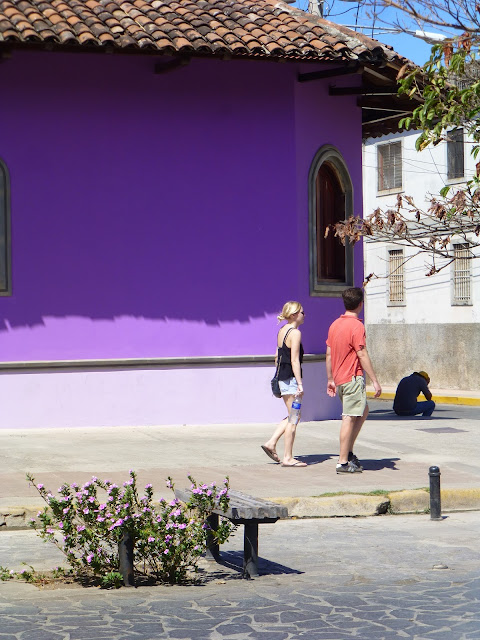
It turned out our visit to Leon coincided exactly with the celebrations marking 100 years since the death of famous Nicaraguan poet Ruben Dario and we noticed that there was an increased security presence in the town square. Upon speaking to some local people we discovered that the President was due to visit that evening for a church service in the cathedral, the largest one in Central America, and that there would be a free concert there the night after. We hadn't really planned to stay a second night but ended up doing so anyway after Evan drank some mango juice that was off and was sick for most of the following day.

It was interesting to see what goes into a Presidential visit in Nicaragua. By the time Daniel Ortega arrived the numbers of security guards and police nearly matched the number of spectators. Eventually the motorcade pulled up in front of the cathedral along with a decoy procession from a different direction, both flanked by police riders on V-stroms which was a nice touch. Talking to locals it seems the President wasn't hugely popular, most were just there out of curiosity it seemed. A downside of the Ruben Dario celebrations, held in Leon as this is where the poet is entombed in the cathedral, was that the roof of the cathedral wasn't open to the public while we were there. A shame, because the otherworldly landscape up there and the views of the surrounding volcanoes really is jawdropping.


After Leon we headed towards Volcan Masaya National Park to check out the possibility of camping there and doing a night hike. It appeared when we arrived there that the gates are only open at certain times so we decided to go and check out Laguna Apoyo instead and return later. It was shortly after this at a hunting store down the road that we had our random meeting with Alfonso.


Alfonso is 78 years old and is originally from Managua, but has lived for many years in North Carolina, working for large environmental corporations. He was back in Nica for a few months in order to oversee the sale of a ranch he owns in Rivas. Upon discovering we were on a motorcycle trip he got very excited and reached for his filofax, out if which he pulled several photos. It transpired that he and his first wife had ridden BMW airheads across the US in the late 60's, quite a feat at the time and he had photos to show us of the bikes and a later Goldwing he subsequently owned. After telling the security guy at the strip mall to guard our bikes he insisted that we go back to his house with him for drinks and that we'd be more than welcome to stay with him as his guest if we'd like. It's random meetings like this that make travelling so worthwhile.

We didn't take him up on his kind offer at that time, instead we headed for Granada that evening, only to find yet again that it was almost dark and everything but the high end hotels were full. An Aussie guy outside a hostel kindly looked us up some hostels that had rooms available on his wifi connection and so I set off with a local guy 'Jeremy' in tow, insistent that he could show me where these places were. Normally I'm totally against encouraging the coyotes, but on this occasion he proved very useful, when after discounting a couple of hostels as not suitable (I can see why they still had beds available!) he found us a room right in town with bike parking in the lobby for just $16 a night. I didn't begrudge giving him a few dollars for some food, although it pissed me off when he asked for even more. That seems to be a typical trait down here though. Less so in some places, but very much the case in Nicaragua.


Granada hasn't changed much. We sat and watched the Superbowl on tourist Street and enjoyed a few mojitos and the following day explored the city. We climbed the church tower to take the opportunity to look out over the city. We climbed the cathedral tower and watched an artist painting a new mural inside on the ceiling. Granada really is a beautifully maintained city for the most part, or so we thought until we wandered into the market area. Markets in Latin America are very different to those back home. Live animals, fresh (and not so fresh) fruits and vegetables and a variety of meats are mixed in amongst household goods, clothing, cheap imported Chinese tat and kids toys. You name it, they probably have it. Granada market takes hygiene to a whole new level though. If you saw how raw meat was presented and traded you'd think twice about eating anywhere in the town!


Upon leaving Granada we headed south, this time with a destination planned. For the majority of this trip we've not planned our route at all. Quite often we have the 'where do you want to go?' discussion as we sit drinking coffee at a service station on route to who knows where. Today though we were heading for Popoyo beach to meet Shannon, another Canadian and ADV poster who had been riding a rental bike around Nica for a couple of weeks after completing one of the crazy Ometepe races the week before.

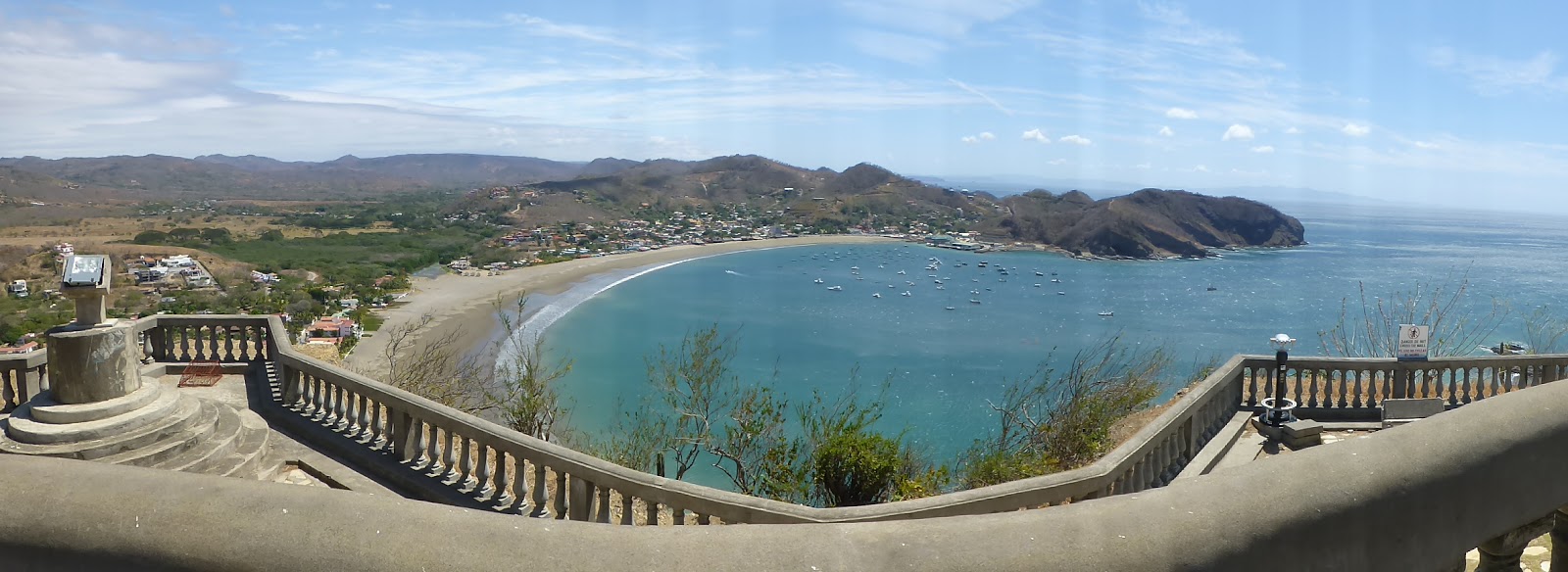
The road to Popoyo shows yellow on Google maps so we were a little surprised when we determined that the road leading away from the main PanAm highway was little more than a dirt track. Still, it was definitely the right road so off we went. After an hour of dodging rocks, sliding on gravel down steep slopes and avoiding a multitude of rogue animals we arrived at Magnific Rock, a higher-standard-than-we're-used-to establishment perched high on the cliffs at Popoyo. Here we met Shannon and exchanged stories from the road over lunch all the while blown away by the stunning panoramic views from the windows of the restaurant. We enquired about the cost of a room, but at $80 a night we couldn't justify it and so we set up our tent at a little campground we'd passed a few yards back down the road. That evening after a few more mojitos we walked along the beach to Popoyo proper for some dinner. On our return the beach was covered with a huge moving carpet of hermit crabs, a memorable experience to witness.


Our last stop in Nicaragua on our journey south was San Juan del Sur. It was midweek so a good time to visit, avoiding the weekend debauchery in what used to be a sleepy fishing village. We found a basic room in a little hostel with parking out back and made ourselves comfortable for a couple of days. The dirt road to Popoyo reminded me just how badly I needed to do something about a problem I've been having with my front brake that has been getting progressively worse. One of the rotors has become warped and this means even very gentle braking results in the front brake pads grabbing the disc. As a result I've become less and less comfortable braking on loose ground, even more so on hills. We decided, with the help of a mechanic friend of the hostel owner to swap the rotors, thus reversing the direction they rotate in the hope this might lessen the problem until I can pick up a new rotor in the US. It was a nice idea, but unfortunately made little difference.

Later that day we had another chance meeting with a Canadian couple halfway through their trip to Argentina on KLR's. They were in San Juan dealing a property deal and kindly invited us to dinner the following night. With another craving for sushi, we found a nice little place inntown that evening and hadn't been sitting there five minutes when who should come walking by but Shaun, the guy with the KLR who'd generously shared his cabin with us on the Baja ferry! We joined us for dinner and we enjoyed catching up on where we'd all been in the months since we'd last met.


Costa Rica we skipped through fairly quickly on the way south. And on the way north too actually. I'm sure plenty of people will disagree with me, but I feel very much the same as I do about Southern California about it. I just don't like it much. I'm not saying there aren't some beautiful places there if you get off the beaten track, but on balance there's far more I don't like. High prices, obnoxious tourists and ex-pats and a constant drain on your budget no matter how cheaply we tried to do things. One small oasis we found though was a little finca owned by a Swiss woman right by the Penas Blancas border. A wonderful little oasis in the jungle and exceptionally helpful people. Lots of wildlife too - crocs in the river, spider monkeys in the trees and less welcome, tics between my toes after a long woodland hike. Otherwise the metal 'Se acceptan American Express' sign above every town name sign pretty much summed up Costa Rica for me.


By the time we made it to Panama I was well in need of some new experiences. I love Central America but a lot of the places we'd spent the last few weeks were places I'd been before. Panama would prove to be just what I was looking for.

Monday, 1 February 2016

One more month, two more countries


I can't believe how quickly time flies when we're on the road. Since I last wrote anything here we've passed clean through two countries and neither particularly quickly.
Upon leaving the Oaxaca coast we headed further east towards San Cristobal de las Casas in Chiapas. I was keen to ride through here as Oaxaca and Chiapas were the places I skipped last time when I was with Sharen, with our last minute change of plan and dash back to the warmth of Quintana Roo.

The ride to San Cristobal involved riding across some open plains covered as far as the eye can see with wind turbines. That should have been a clue as to what was to follow, along with the frantically waving officer in a police car heading in the opposite direction, shaking his head and indicating for us to turn around and a rushed conversation in Spanish that we didn't fully understand with a tuc-tuc driver at a red light. The next twenty miles or so was hell. The strongest crosswinds we've experienced yet, we rode at what felt like close to 45 degrees, each successive gust seemed stronger as we fought to keep our bikes on our own side of the road and out of the path of oncoming semis. We made it, my nerves shot to pieces and later discovered that we'd only caught the start of the storm. Other riders we met later who came through the same way in the following days reported that conditions only got worse. One couple ended up riding through under police instruction alongside a large truck which was used as a windbreak. I'm not sure if that would have appealed, given the large number of similar trucks we've seen on their sides in ditches after losing their battle against the wind.

It was also on the way to San Cristobal that we met the first of the infamous road blocks. In this case an unruly mob had barricaded the road with dirt and rubble, forcing everyone to take a detour into their 'toll' lane. Traffic moved slowly, I presume as each successive person argued against paying. When we made it to the head of the queue Evan debated for several minutes with the protesters but to no avail. Eventually we switched off our engines and a guy who could speak English came to try his luck. He explained to us that they were collecting money to build a school and eventually dropped his demand to just 50 pesos (less than $3 USD) for us both so we reluctantly paid and were on our way. It was frustrating though. I highly doubt these people were teachers or parents and to extort money in such a way doesn't sit right with me. If their cause was genuine, as we tried to explain to them, we'd be more likely to donate, but not when money is demanded in such a way. Our efforts fell on deaf ears.

A few towns further along the road had been blocked with large lumps of concrete and other debris and again we were forced to detour down rocky back roads. This time though we arrived just as the protest was starting and no money was being demanded. We sat outside an Oxxo store and talked with a very friendly local man who tried his best to explain their cause (we later translated a document he gave us and it was about promises about healthcare, children's services and road maintenance made by the local government that hadn't been kept) before we continued on our way.

San Cristobal was a nice enough colonial town, a lot like a lot of others. We stayed a few days and during this time went to see the new Star Wars movie on opening night in 3D, in English and with only about 20 other people. Best of all it cost us less than $4 USD each!


One of our reasons for staying so long in San Cristobal was because this was where we had our first big 'what's the point of all this?' talk. It started with a comment about money and how much we were spending and ended up being a long discussion about what we both hoped to gain from this trip. One thing became clear – neither of us we were feeling satisfied, things had become routine and tedious.

I think now is a good time to point out that a trip like this is hard work. People constantly remark that 'it must be amazing' or 'you're so lucky to be so free and on this trip of a lifetime' but the reality is very different. It's fun, of course it is, but it's also bloody hard work. At the end of the day when we're tired both mentally and physically, we still have to find a place to stay that has parking, often in a language we don't understand. We have to keep up with bike maintenance, trying to work out where we're going to get the next part we need in a place where big bikes like these are far from common. We have to be careful how much we spend because there's nothing coming in to replace it. We have to deal with the realities of life on the move and as well as all the fantastic people we meet there are the noisy, antisocial ones who happen to be in the room next to us when we desperately need a good nights sleep. There are also the other noises that are impossible to control – barking dogs, roosters, firecrackers at 4am, church bells, bin men doing their rounds at 5am. In short, life on the road isn't all roses.

And so we had a long chat and came to the conclusion that 1) we were spending more than we had anticipated, 2) that we were in desperate need of some Spanish lessons and 3) that the bikes we have are the wrong bikes for Central and South America, they're just too big. This said, coupled with our growing feelings of dissatisfaction at simply getting up, riding all day, sleeping and repeating, we decided that we wanted to focus on quality of experience over distance. Getting to South America would mean using a chunk of money that neither of us want to spend, not with these bikes, and so we came to the conclusion that riding only as far as Panama and then turning around and riding back to Canada in the spring was a much better plan.

With Christmas fast approaching, we decided to make a run for Chetumal and cross into Belize. Having been to Belize a couple of times before, there was only one logical place to head for – Hopkins. The border crossing was simple enough. They all are so long as you're patient and arrive early enough. It took a little longer to ride down to Hopkins, taking alternative routes through the north of Belize on the advice of some concerned locals and then dodging potholes on the Hummingbird Highway. It hadn't occurred to me that this was where the trip idea began until we were riding down that road. Upon arrival in Hopkins we headed for the Dodo and decided to stay there a night before looking for a free camping spot the following day. As per usual a few days turned into two weeks. We met some lovely people at the Dodo and ended up camping across the road from the hostel until our insurance ran out. It gave us some much needed down time, a chance to fix an issue with my fuel filter and a chance to catch up with friends we'd made there previously. Emma, the Swedish girl who rented us the little dirt bike on our last visit, kindly invited us to a potluck dinner on Christmas day with a mixture of locals and ex-pats. It was a great opportunity to see first hand the local politics of the place. Later she also kindly let us use her workshop to fix an issue I had with my fuel filter. For New Year we partied at Windschief with a group of hostel residents and locals after enjoying some of the best fish and chips I've ever had.


Upon leaving Belize we headed straight for Flores. Again, the border crossing couldn't have been more simple. I really don't get why people get so het up about them. Get yourself stamped out, get the bike stamped out. Cross no-man's land and stamp yourself in, followed by the bike. It's a piece of cake even with very limited language skills. Unfortunately the weather wasn't on our side this time. From the time we left Hopkins until our arrival in Flores, it poured. Luckily the road from the border to Flores is now 90% paved, but even so the rain made life difficult. I narrowly avoided dumping my bike after having to brake hard for a pig that ran out in front of me. We were soaked through by the time we arrived so we parked the bikes and Evan stayed with them while I traipsed around looking for a place to stay. Having been there before it wasn't hard to find somewhere and we were soon warm and dry.

We'd only planned to stay a night, but ended up staying several. Some people we'd met in Hopkins and then again in Flores told us that a local festival was about to start and so we decided to stick around for that. It was called the Dance of the Chotona (doll) and involved lots of firecrackers and explosions, almost hourly parades and lots of festivities. The grand finale of the night was a guy with a wooden crate on his head covered in fireworks charging around the town square into the crowd with rockets firing off in every direction. The kids loved it. Only in Guatemala.


Eventually we left Flores and headed south, our intention to find an affordable Spanish school and get on with some lessons. After an interim stop on the way down in one of the worst hotels we've experienced yet and a ride on a particularly inventive ferry/barge across a river, we arrived in Antigua, another colonial town and tourist central.


Again, nice enough, but neither of us could really get into the vibe of the place. At weekends it filled up with party seekers from Guatemala City, but even during the week it was busy and expensive. We stayed a few nights, had a lovely dinner with a local guy and his wife that we'd previously talked to on Advrider and met another couple from Oregon riding a similar trip to ours on F650's. It was interesting talking to them because it turns out they'd been having similar conversations about how hard it is at times to stay positive on the road. One thing that pulls us back time and time again though is the people. I've lost track of the number of total strangers we've talked to on the street who have written down their phone number and address in my little notebook, insisting that we come and stay or call them should we need anything at all.


After deciding very quickly that Antigua wasn't the place for us to go to school, we set off for Lake Atitlan. To be honest we weren't really sure where we were heading, but it certainly wasn't where Google decided to take us. Pavement gave way to dirt roads as we entered a small village and soon we found ourselves on a cow path, complete with local cowboys herding cows. As it got muddier and more deeply rutted I lost my nerve for the first time on this trip and didn't want to go any further. Luckily we were only a kilometre or two from the highway at this point and going back would have been far worse so Evan took my bike through the last boggy bit for me (and dropped it) and we were on our way again. Roads like that make me hate my big, heavy bike and really knock my confidence. Gravel, dirt or small rocks? Fine. Deep sand, mud or big rocks? Not fine.


That evening we arrived in Panajachel and immediately liked it. It's grittier than Antigua with one long tourist street, but plenty of non-touristy areas too. It seemed there were two main schools in town and upon visiting the first we signed up for a week of lessons on the spot, and later added a second week. We debated accommodation and decided against a homestay. Both of us value our space and the thought of having to be sociable 24/7 and not having control over our meals didn't appeal, so after walking around what must have been half of the town's 96 hotels asking about prices, the owner of the place we were already staying relented and offered us a discount on the nightly rate and so we decided to stay. We ate most nights at a tostada stand for a couple of dollars and followed this up far too often with a slice of the best meringue pie I've had in a very long time at the stand next door.


Spanish school was great. We decided to go with four hours of lessons a day, but in reality this was a bit too much. It's hard trying to absorb so much information and despite our teacher Florinda's best efforts, I often found myself at overload point by the end of the third hour. Two weeks in one stretch was definitely enough for starters. We had a lot of fun though and it was a learning experience in both directions as we explained to Florinda how things work in Canada and the UK. She taught me how to say 'Evan smells like Shrek after he eats beans' in Spanish so it was money well spent.


I don't usually write much about accommodation, but we've stayed in some choice places on this trip. Our quest for cheapest often finds us in situations where in hindsight we wish we'd paid the extra dollar. Be it for wifi. Or a toilet seat. Or for toilet paper to be included. Or for the water to work. We've stayed in a couple of really dire places. We've slept with ant infestations. We've had no running water. We've stayed in places so noisy that how anyone slept there was beyond us. We've survived near electrocution from bare wires sticking out of walls. Luckily our hotel in Pana was none of these things, in fact it was quite pleasant. The owner was a little odd, but only in the usual way that we've found so many Guatemalan businessmen to be and mostly only when it comes to money. There's a tendency here to clearly quote one price and then when you come to pay, suddenly it's a dollar or so more. Such small amounts mean that people rarely complain, but it soon adds up. We later found out that he'd run for mayor twice and come last both times which explained a lot. What was most notable about this hotel though was its other inhabitants.

End of hallway – American wannabe-hippy yoga teacher, about the same age as me. Sometimes she spoke to us, sometimes she just smiled and said nothing. When she did talk she did so in that unnerving voice that people usually reserve for babies and animals. She wouldn't have been annoying at all had she not decided to sit on the floor, in the doorway to our room, virtually on my feet, to watch her hippy guru videos on her laptop. Every day. Especially when we sat down to eat at our little table on the balcony. Why? Who knows. She had ample room outside her own room. Maybe our distaste for this became apparent to her after a while because a few days before we left she stopped doing it. Or maybe she failed to make us snap and gave up.

Next door to the left – French family. Loud, French-only speaking French family with bratty three year old kid. This kid ruled the place. He shouted for his dad continuously, ran around screaming and shouting and every time we sat down to do our Spanish homework his parents would decide to hand him an ipad to watch kids shows very loudly in French or else they'd decide to give him a school lesson loudly in French. Did I mention they were LOUD? The last day they were there they decided to pack all their things very loudly on the balcony outside our room at 5.30am, just like those annoying people who should never be allowed to stay in hostel dorms do. On top of a largely sleepless night due to dogs barking, bins being dragged down the alleyway outside, etc they were the final straw. Evan stormed out and gave them a piece of his mind and I don't blame him.

Next door to the right – retired Dutch guy, also at the same Spanish school as us and a long term resident. Nice guy, a little arrogant when we first arrived, but he mellowed the longer we stayed. Various other people came and went, but no-one of note. For a place down an alley away from the main drag though, it was incredibly noisy and we had many sleepless nights there. The irony of being randomly asked at 11pm one night to turn our television down when it was already barely audible from within the room completely baffled us. On our last night a lonesome dog decided it was going to sing from 2am until 6am. We weren't sorry to get out of there.
It was in Panajachel that I first realised how much of a problem street dogs can be. Don't get me wrong, I love dogs and generally they don't bother me, but in Pana they roam in large packs, make a lot of noise and are quite intimidating at times. A few nights before we left we were eating dinner in a nice little restaurant and despite the waiting staff chasing them out repeatedly, several dogs that had gathered in the restaurant decided to start fighting. Later we had to chase a couple of large dogs away from a little old Mayan lady who was struggling to fend them off as they jumped up and snapped at her as she tried to sell her wares. Apparently when the problem reaches a certain level the local authorities poison the dogs and while I can't condone this as a solution, clearly one is needed. Many of the dogs there have been fixed and re-released, but lots haven't. Usually I have every sympathy with animals living such a tough life on the street, but for some reason in this town they bothered me. Their continuous noise and fighting all night, their sheer numbers. It was too much.


When we left Pana we had already decided to head for the El Salvador border. After much debate and research (and a hundred different answers from different people) we decided against extending our Guatemalan visas and TVIP's. It would have been a lot of hassle and waiting around for this to be processed and would have only bought us about 30 days of extra time, so therefore we decided to make our way straight to Panama and then work our way back north within the time limits permitted. Whether to ride through El Salvador or straight to Honduras wasn't a hard decision to make. We've heard only good things about El Salvador and it would be a shame not to see the country, especially as I skipped it last time.

First though we had to stop in Guatemala City to pick up a rear tyre for Evan's bike. Simple enough task, except when you've got multiple lanes in each direction, a metrobus system in the middle and a wrong turn means an hour of trying to find a way to get back on track. After finding ourselves heading in the wrong direction not for the first time and with no Retorno in sight, Evan decided to try and cut across the metrobus lanes, in between the concrete blocks with us only narrowly escaping into the opposite stream of traffic as an approaching police truck with its lights flashing came to aprehend us, we decided enough was enough and pulled into a McDonalds parking lot. After a heated discussion about the validity of using metrobus tracks as turning places, we decided that I'd stay with the bikes while Evan got a taxi to take him the 2km to the BMW dealer to collect the tyre.
Two hours later and still no sign of him, I started to worry. I'd sat on the kerb, gone in and bought a drink so I could smile at the security guards and show I was indeed a customer, walked around a bit and talked to probably 30 different local bikers who'd arrived and left, and still no sign of Evan. Just as I was wondering what on earth my options were to track him down, a taxi rolled up and he climbed out. It turned out the taxi driver had 'misinterpreted' his request and taken him to a military base miles away. Then he'd run out of gas and they'd had to push the car to a gas station. Eventually they'd made it to BMW, fighting through appalling traffic jams, got the tyre and returned. On a positive note this had given us both time to calm down after our earlier cross words and a little after 4.30pm we set off out of town. Far too late to get anywhere very much so we just rode until it was almost dusk and stopped in a place a little south of the city. The next day – El Salvador and the unknown for us both.